An Expert Guide to Organic Chemistry for the IMAT
Complete syllabus coverage: Bonding, Hybridization, IUPAC Nomenclature, 3D Stereochemistry, Mechanisms, Aromaticity, Functional Groups & Combustion Analysis.
Introduction
This report provides a comprehensive, clear, and strategically focused guide to the Organic Chemistry section of the International Medical Admissions Test (IMAT) syllabus. The objective is to distill the core principles of organic chemistry into an accessible yet exhaustive resource, tailored specifically to the requirements of prospective medical students.
A robust understanding of organic chemistry is not merely about covering syllabus points; it is about securing a competitive advantage. Mastery of this subject demonstrates a capacity for logical reasoning and pattern recognition, skills that are invaluable in medical science.
This guide is structured to build knowledge logically. By focusing on the underlying patterns and principles, the complex world of organic reactions becomes a manageable and logical field of study.
Part 1: The Foundations of Organic Structure & Hybridization
1.1 The Unique Nature of Carbon: Bonding and Hybridization
Organic chemistry revolves around Carbon (#6). Out of all 118 elements, carbon is uniquely suited for building complex biological machinery due to three key properties:
- Tetravalency: Carbon has 4 valence electrons and forms exactly 4 strong covalent bonds.
- Catenation: Carbon can bond to other carbon atoms infinitely to form stable linear chains, branched networks, and rings.
- Moderate Electronegativity: Carbon shares electrons evenly with Hydrogen (non-polar), but also forms polar bonds with Oxygen, Nitrogen, and Halogens.
The Puzzle of Methane (CH_4): Orbital Hybridization
Ground-state carbon (1s^2 2s^2 2p^2) has only two unpaired electrons. However, methane forms four identical bonds in a tetrahedral shape with 109.5° bond angles. Orbital hybridization describes the mathematical mixing of one 2s and three 2p atomic orbitals to create four equivalent sp^3 hybrid orbitals.
sp^3 Hybridization (Alkanes)
In sp^3 hybridization, one 2s and three 2p orbitals combine into 4 identical hybrid orbitals directed towards the corners of a tetrahedral geometry (109.5°). This is characteristic of single-bonded alkanes.
sp^2 Hybridization (Alkenes)
One 2s mixes with two 2p orbitals to form three sp^2 hybrid orbitals in a trigonal planar layout (120°), leaving one unhybridized 2p orbital. This architecture enables C=C double bonds (one \sigma bond and one \pi bond).
sp Hybridization (Alkynes)
One 2s mixes with one 2p orbital to form two sp hybrid orbitals arranged in a linear geometry (180°), leaving two unhybridized 2p orbitals. This allows triple bonds (one \sigma and two \pi bonds).
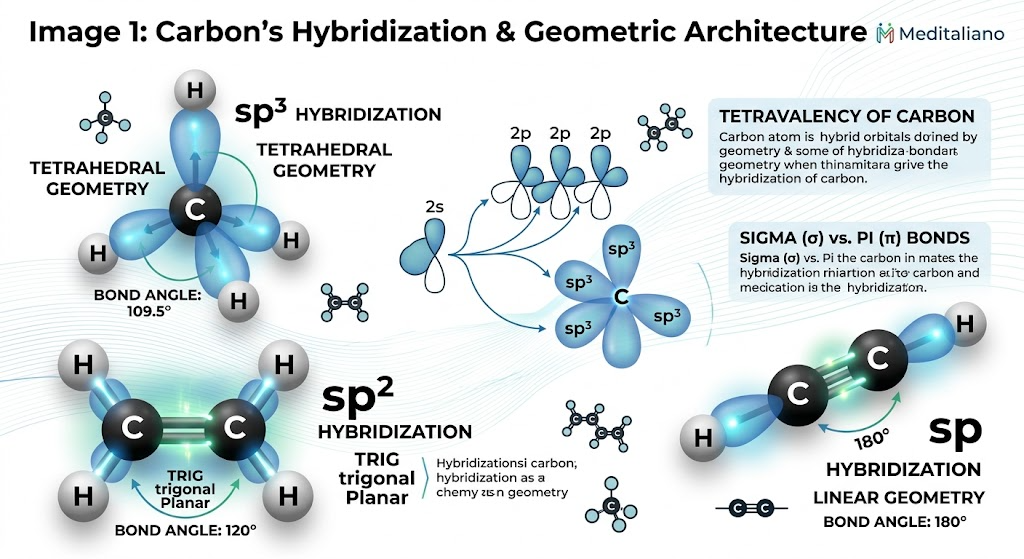
📸 Source / Diagram: Figure 1.1: Carbon's Hybridization and Geometric Architecture (sp³ Tetrahedral 109.5°, sp² Trigonal Planar 120°, sp Linear 180°).
| Table 1.1: Summary of Carbon Hybridization | ||||
|---|---|---|---|---|
| Hybridization | Electron Groups | Geometry | Bond Angle | Example |
| sp^3 | 4 | Tetrahedral | 109.5° | Ethane (CH_3CH_3) |
| sp^2 | 3 | Trigonal Planar | 120° | Ethene (CH_2=CH_2) |
| sp | 2 | Linear | 180° | Ethyne (HC \equiv CH) |
1.2 Sigma (\sigma) vs. Pi (\pi) Bonds
| Bond Type | Orbital Overlap | Rotation | Strength & Reactivity |
|---|---|---|---|
| Sigma (\sigma) | Head-on overlap along the internuclear axis. | Free rotation allowed around single bonds. | Strongest covalent bond. Unreactive. |
| Pi (\pi) | Lateral (side-by-side) overlap of unhybridized p-orbitals. | Restricted rotation. Locks geometry (Cis/Trans). | Weaker than \sigma. Electron-rich & reactive. |
Index of Hydrogen Deficiency (IHD / Degree of Unsaturation)
Calculates the total number of rings and π-bonds in a molecule. Oxygen (O) and Sulfur (S) are ignored. Halogens (X = F, Cl, Br, I) subtract 1/2.
Example: Benzene (C_6H_6) → IHD = 6 + 1 - (6/2) = 4 (1 ring + 3 double bonds = 4 degrees of unsaturation).
Part 2: Chemical Formulas and Skeletal Representations
2.1 Representing Molecules
- Empirical Formula: Simplest whole-number ratio of elements (e.g., CH_2O for glucose).
- Molecular Formula: Exact count of each atom in a molecule (e.g., C_6H_{12}O_6 for glucose).
- Structural Formula: Displayed, Condensed, or Skeletal (Line-Angle) drawings.
Skeletal Structure Rules
In line-angle skeletal structures:
- Every line end or vertex represents a Carbon atom.
- Hydrogen atoms attached to Carbon are hidden (implied to complete 4 bonds per Carbon).
- Heteroatoms (O, N, S, Halogens) and their explicit Hydrogens must always be drawn.
Part 3: IUPAC Classification and Nomenclature
3.1 The Master Priority Table
When a molecule contains multiple functional groups, the highest priority group determines the suffix (name ending), and the chain is numbered from the end nearest to this group.
| Table 3.1: IUPAC Functional Group Priority Table | ||||
|---|---|---|---|---|
| Priority | Class | Formula | Suffix | Prefix |
| 1 (Highest) | Carboxylic Acid | -COOH | -oic acid | carboxy- |
| 2 | Ester | -COOR | -oate | alkoxycarbonyl- |
| 3 | Amide | -CONH_2 | -amide | amido- |
| 4 | Nitrile | -C \equiv N | -nitrile | cyano- |
| 5 | Aldehyde | -CHO | -al | oxo- (formyl) |
| 6 | Ketone | >C=O | -one | oxo- |
| 7 | Alcohol | -OH | -ol | hydroxy- |
| 8 | Amine | -NH_2 | -amine | amino- |
| Lowest | Alkyl / Halogen / Ether | -R / -X / -OR | -ane | alkyl- / halo- / alkoxy- |
IUPAC Naming Master Algorithm
- Identify Principal Group: Determine the highest priority group from Table 3.1 to establish the suffix.
- Find Parent Chain: Locate the longest continuous carbon chain containing the principal functional group.
- Number Main Chain: Number from the end that gives the principal functional group the lowest possible locant number.
- Assemble Substituents: Name prefixes alphabetically (ignore di-, tri-, tetra- prefixes).
Part 4: 3D Stereochemistry and Isomerism
4.1 Classification of Isomers
Isomers are compounds with identical molecular formulas but different chemical or 3D structural arrangements.
1. Constitutional (Structural) Isomers
Different covalent bonding connectivity:
- Chain Isomerism: Different carbon backbone (e.g., n-butane vs. isobutane).
- Positional Isomerism: Functional group at a different position (e.g., 1-propanol vs. 2-propanol).
- Functional Group Isomerism: Different functional group family (e.g., ethanol vs. dimethyl ether).
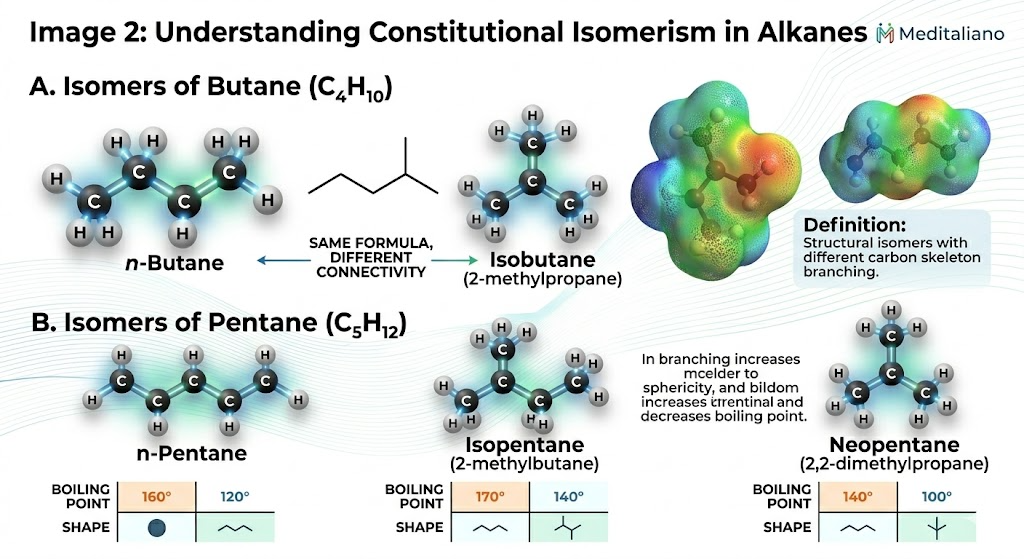
📸 Source / Diagram: Figure 4.1: Constitutional Isomerism in Alkanes (n-butane vs isobutane C₄H₁₀).
2. Stereoisomers
Same bonding connectivity, but different spatial orientations:
Geometric Isomers (Cis-Trans & E/Z)
Result from restricted rotation around C=C double bonds or ring structures. Cis = substituent groups on the same side; Trans = substituent groups on opposite sides.
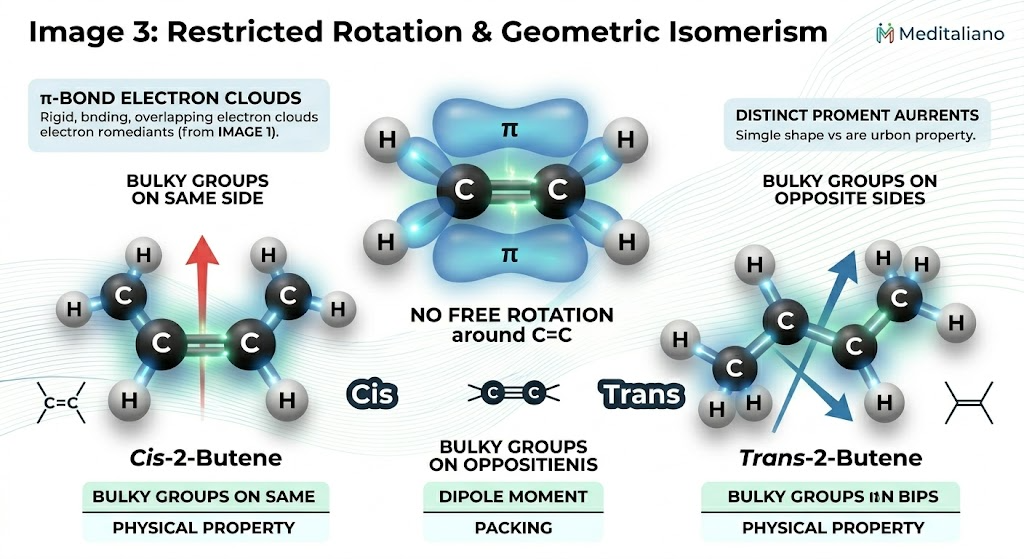
📸 Source / Diagram: Figure 4.2: Restricted rotation around π-bonds leading to Geometric Isomerism (cis-2-butene vs trans-2-butene).
Enantiomers & Absolute Configuration (R/S System)
An asymmetric (chiral) carbon is an sp^3 carbon bonded to four completely different groups. Enantiomers are non-superimposable mirror images.
Cahn-Ingold-Prelog (CIP) R/S Assignment Rules
- Assign priority (1 to 4) to the 4 attached groups based on Atomic Number (Z) (-Br > -OH > -CH₃ > -H).
- Orient the lowest priority group (#4, usually H) pointing away (dashed wedge).
- Trace a path from group 1 → 2 → 3.
- Clockwise = (R) [Rectus], Counter-clockwise = (S) [Sinister].
- Master Trick: If group #4 points TOWARDS you (solid wedge), trace normally and REVERSE your result!
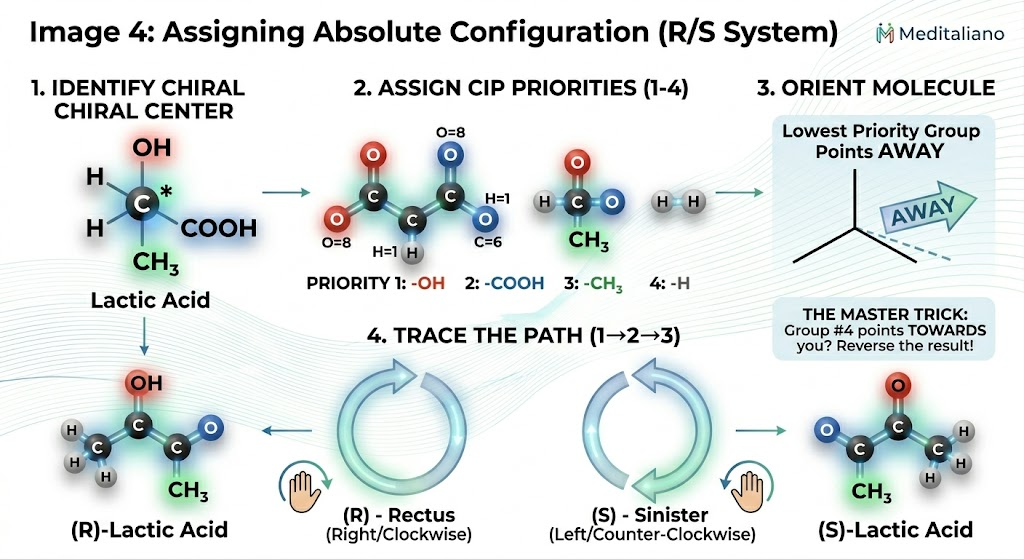
📸 Source / Diagram: Figure 4.3: Assigning Absolute Configuration (R/S System) for Enantiomers of Lactic Acid.
Part 5: Fundamental Organic Reactions & Mechanisms
5.1 Free-Radical Halogenation of Alkanes
Alkanes undergo radical substitution in the presence of UV light (h\nu):
- Initiation: Homolytic cleavage of halogen bond (Cl_2 \xrightarrow{h\nu} 2Cl^\bullet).
- Propagation: Radical abstracts H atom creating alkyl radical (CH_4 + Cl^\bullet → ^\bullet CH_3 + HCl).
- Termination: Combination of two radicals to form a stable bond.
5.2 Electrophilic Addition to Alkenes & Markovnikov's Rule
The electron-rich \pi bond attacks electrophiles. In unsymmetrical alkenes, addition follows Markovnikov's Rule: the hydrogen adds to the carbon with more hydrogens, creating the most stable carbocation intermediate (3^\circ > 2^\circ > 1^\circ).
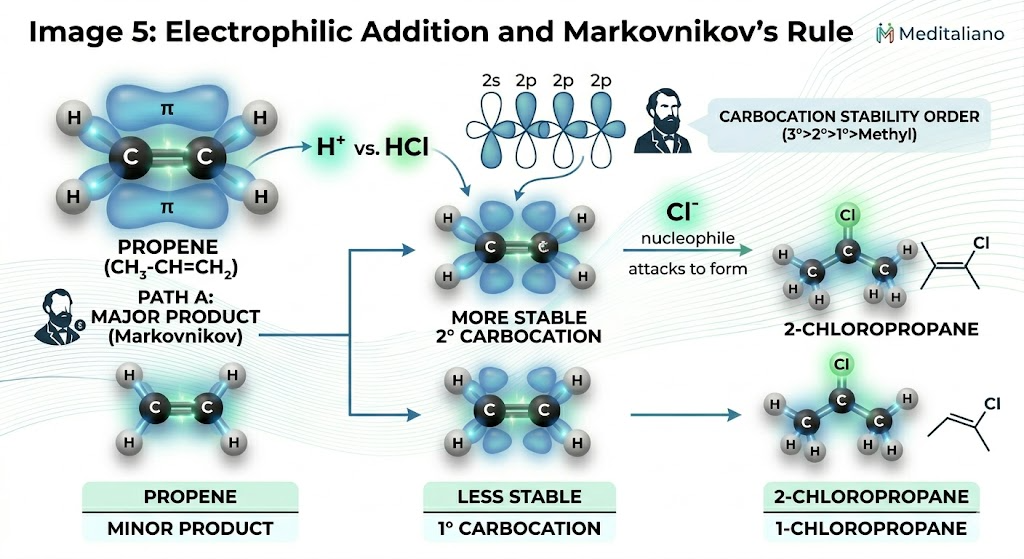
📸 Source / Diagram: Figure 5.1: Electrophilic Addition Mechanism & Markovnikov's Rule (Hydrohalogenation of propene to 2-bromopropane).
| Reaction Type | Reagents | Product | Regiochemistry |
|---|---|---|---|
| Hydrohalogenation | HX (HCl, HBr) | Haloalkane | Markovnikov |
| Hydration | H_2O, H^+ | Alcohol | Markovnikov |
| Halogenation | Br_2 in CCl_4 | Vicinal Dihaloalkane | Anti-addition (Trans) |
| Hydrogenation | H_2 + Ni/Pt/Pd | Alkane | Syn-addition (Cis) |
Part 6: Aromaticity and Benzene
6.1 Benzene (C_6H_6) & Hückel's Rule
Benzene does not undergo addition reactions because its \pi electron ring is exceptionally stable due to resonance delocalization.
Hückel's Criteria for Aromaticity
- The molecule must be Cyclic.
- The molecule must be Planar (all ring atoms sp^2 hybridized).
- The ring must be Fully Conjugated.
- Contains 4n + 2 delocalized \pi electrons (where n = 0, 1, 2... → 2, 6, 10, 14 electrons). Benzene has 6 \pi electrons.
Part 7: Functional Groups and Key Transformations
7.1 Oxidation Pathways of Alcohols
- Primary (1^\circ) Alcohols: Oxidized to Aldehydes (mild oxidizer like PCC) → Carboxylic Acids (strong oxidizer like KMnO_4 / K_2Cr_2O_7).
- Secondary (2^\circ) Alcohols: Oxidized to Ketones.
- Tertiary (3^\circ) Alcohols: Resistant to oxidation (no C-H bond on the alpha carbon).
Fischer Esterification
Part 8: Elemental & Combustion Analysis
8.1 Determining Empirical and Molecular Formulas
Empirical Formula Calculation Algorithm
Mass of Oxygen = Total Sample Mass - (Mass C + Mass H). Divide all molar amounts by the smallest value to obtain the empirical integer ratio.
Conclusion
Success in the IMAT Organic Chemistry section hinges on mastering a few high-yield concepts. The most critical skills are the rapid recognition of functional groups, rapid calculation of IHD, applying Markovnikov's rule, and assigned absolute configurations (R/S) using the CIP priority rules.
A pattern-based approach to organic reactions is paramount. Rather than memorizing dozens of individual reactions, focus on core mechanisms of addition, substitution, and elimination.